Concrete Pipe Production Process: From Raw Materials to Finished Pipes

Updated: Aug 14
The Concrete Pipe Production Process involves several carefully controlled stages, from preparing raw materials to forming, curing and inspecting the finished pipe. A well-designed production process helps manufacturers achieve consistent dimensions, high concrete density and reliable product quality.
Modern concrete pipe machines combine moulding, vibration, compaction and hydraulic systems to improve production efficiency and consistency.For a general overview of concrete pipe manufacturing equipment, manufacturers can also review the Concrete Pipe Machine: Complete Guide to Concrete Pipe Production.
What Is the Concrete Pipe Production Process?
The Concrete Pipe Production Process starts with preparing a suitable concrete mixture and ends with curing and quality control.
Concrete pipes are commonly manufactured for drainage, sewage, irrigation, road infrastructure, stormwater systems and other construction projects.
The main production stages include:
Raw material preparation
Concrete mixing
Mould preparation
Mould filling
Vibration and compaction
Pipe forming
Demoulding
Curing
Quality control

Raw Materials for Concrete Pipe Production
The quality of the finished pipe begins with the correct selection and preparation of raw materials.
The main materials generally include:
Cement: Provides the binding material required for concrete strength.
Aggregates: Sand and other aggregates form the main structure of the concrete mixture.
Water: Water is necessary for the cement hydration process and affects concrete workability.
Admixtures: Depending on project requirements, suitable additives may be used to modify concrete properties.
A consistent concrete mixture is essential for stable production and uniform pipe quality.
Concrete Mixing and Mould Preparation
After the raw materials are prepared, they are mixed to achieve the required consistency.
At the same time, the appropriate concrete pipe mould is prepared. The mould determines the diameter, height and shape of the finished pipe.
CONMACH concrete pipe machines use mould configurations that can include external moulds, internal moulds and fiber caps, depending on the machine model.Manufacturers producing several pipe sizes should carefully evaluate the Concrete Pipe M ould: Types, Uses and How to Choose the Right One options available for their production requirements.
Filling, Vibration and Compaction
Prepared concrete is transferred into the machine and placed inside the mould.
The vibration system then compacts the concrete. Proper vibration helps reduce air voids and creates a denser and more uniform concrete structure.
This stage is particularly important because insufficient compaction can affect the strength, surface quality and durability of the finished pipe. The relationship between mould filling, vibration and forming is explained in more detail in the How Does a Concrete Pipe Machine Work? Complete Production Guide production guide.
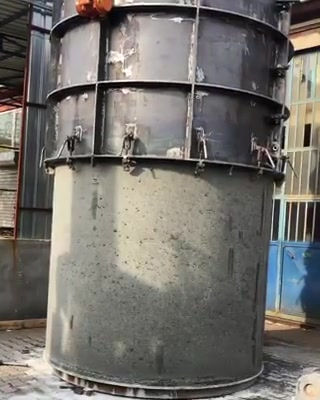
Forming and Demoulding
During forming, the machine shapes the concrete according to the mould dimensions.
Hydraulic and mechanical systems control the production cycle. After the pipe has been formed, the mould is removed and the fresh concrete pipe is transferred for curing.
CONMACH machines use hydraulic systems and, depending on the configuration, hydraulic transport trolleys for handling produced pipes.
Curing and Quality Control
Curing is an essential stage of Concrete Pipe Production because the fresh concrete needs suitable conditions to develop strength.
After curing, manufacturers should inspect the finished pipes for:
Diameter
Pipe height
Wall thickness
Roundness
Surface quality
Visible cracks
Joint dimensions
Quality control helps ensure that manufactured pipes meet the required project specifications. Proper maintenance of the production equipment can also help maintain consistent manufacturing performance. Manufacturers can learn more from the Concrete Pipe Machine Maintenance: Essential Guide for Long-Term guide.

Choosing the Right Concrete Pipe Machine
The machine used in the Concrete Pipe Production Process should match the manufacturer's required pipe sizes and production volume.
CONMACH offers configurations covering different production ranges, including Ø150–800 mm and Ø300–1,200 mm models. The machines can also be designed according to customer requirements.
Manufacturers should consider pipe diameter, production capacity, mould requirements, factory space, handling equipment and maintenance support before choosing a machine.For manufacturers comparing different machine capacities and diameter ranges, the PIPEKING-800 vs PIPEKING-1400: Which Concrete Pipe Machine Is Right for You? comparison can be useful.
From Concrete Mixture to Finished Pipe
A successful Concrete Pipe Production Process requires more than a good machine. Consistent raw materials, suitable moulds, correct vibration, proper curing and regular quality control all contribute to the final product.
When these stages are properly coordinated, manufacturers can produce durable and dimensionally consistent concrete pipes for a wide range of infrastructure applications.For drainage-specific applications, manufacturers can also explore the Concrete Pipe Machine for Drainage Projects: A Complete Guide guide.
Frequently Asked Questions
What is the Concrete Pipe Production Process?
The Concrete Pipe Production Process includes concrete preparation, mould filling, vibration, compaction, forming, demoulding, curing and quality control.
What materials are used to produce concrete pipes?
The main materials are cement, aggregates and water. Suitable admixtures may also be used depending on the required concrete properties.
Why is vibration important in concrete pipe production?
Vibration compacts the concrete inside the mould, helping reduce air voids and create a dense, uniform pipe structure.
How important is the mould?
The mould determines the dimensions and shape of the finished pipe. Correct mould selection is therefore essential for accurate production.


Comments