Concrete Pipe Machine for Drainage Projects: A Complete Guide

Updated: Aug 23
A Concrete Pipe Machine for Drainage Projects provides an efficient solution for manufacturing precast concrete pipes used in stormwater, road drainage, sewage and infrastructure applications. Concrete pipes are widely used because they offer strength, durability and consistent dimensions when produced under controlled conditions.
For manufacturers supplying drainage projects, choosing the right Concrete Pipe Machine is essential for meeting different pipe diameter and production requirements.

Why Are Concrete Pipes Used for Drainage?
Concrete pipes are commonly used to transport and control water below roads, buildings and infrastructure areas.
They can be used for:
Stormwater drainage
Road drainage
Sewage systems
Agricultural drainage
Irrigation projects
Culverts
Underground water systems
Their strength and long service life make precast concrete pipes suitable for demanding underground applications.
How Does a Concrete Pipe Machine Support Drainage Production?
A Concrete Pipe Machine for Drainage Projects forms fresh concrete inside specially designed moulds. Vibration and compaction help create a dense and uniform pipe structure.
The production process generally includes:
Preparing the concrete mixture
Preparing the pipe mould
Filling the mould
Vibrating and compacting the concrete
Forming the pipe
Demoulding
Curing
Quality control
Consistent production is particularly important for drainage pipes because accurate dimensions help ensure proper installation and connection between pipe sections.
For a detailed explanation of these stages, see the Concrete Pipe Production Process: From Raw Materials to Finished Pipes.
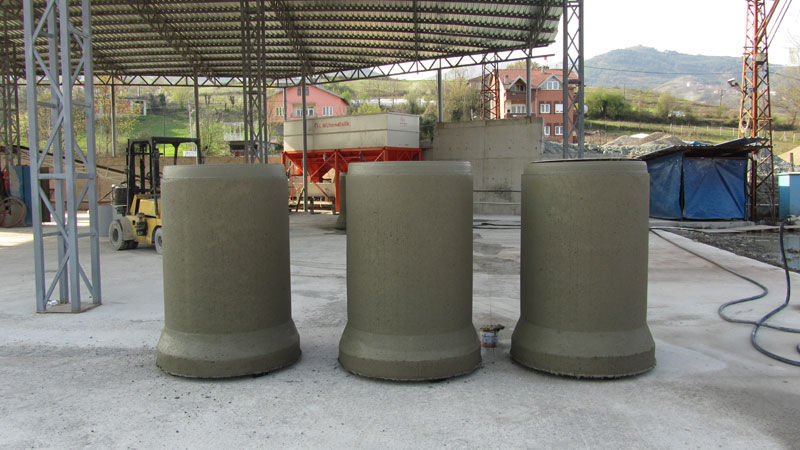
Three large precast concrete pipe sections standing under a steel-framed industrial shelter, ready for infrastructure use. In the background, a concrete batching plant and a forklift are visible at the production facility.
Choosing the Right Pipe Diameter
Different drainage projects require different pipe diameters.
Small diameter pipes can be suitable for certain drainage and irrigation applications, while larger diameter pipes may be required for major stormwater systems, culverts and infrastructure projects.
For this reason, manufacturers should determine the pipe diameter range required by their target market before selecting a Concrete Pipe Machine.
CONMACH offers different concrete pipe machine configurations for various pipe diameter requirements, allowing manufacturers to select equipment according to their production needs.
Concrete Pipe Moulds for Drainage Applications
The Concrete Pipe Mould is an important part of the production process.
The mould determines the external diameter, internal diameter, wall thickness and overall dimensions of the finished pipe.
Manufacturers producing different drainage pipe sizes may require multiple mould configurations.
Maintaining mould accuracy is important because dimensional variations can create installation problems on construction sites. For more information about mould selection, see the Concrete Pipe Mould: Types, Uses and How to Choose the Right One.

Quality and Durability of Drainage Pipes
The quality of a drainage pipe depends on several factors, including concrete mixture, compaction, mould accuracy and curing.
A properly operated Concrete Pipe Machine can help manufacturers produce pipes with consistent dimensions and dense concrete.
Quality control should include checking:
Pipe diameter
Wall thickness
Pipe length
Surface quality
Roundness
Joint dimensions
Visible cracks or defects
Why Production Capacity Matters
Drainage projects can require large quantities of concrete pipes within specific delivery schedules.
Manufacturers should therefore consider both pipe diameter and expected production volume when selecting machinery.
A machine with the correct capacity can help maintain production schedules while avoiding unnecessary investment in equipment that exceeds actual requirements. Manufacturers comparing different production ranges can review the PIPEKING-800 vs PIPEKING-1400: Which Concrete Pipe Machine Is Right for You? comparison.
Selecting a Concrete Pipe Machine for Your Business
When choosing a Concrete Pipe Machine for Drainage Projects, manufacturers should evaluate:
Required pipe diameters
Production capacity
Mould requirements
Factory space
Automation level
Handling equipment
Maintenance requirements
Technical support
The machine should be selected according to current projects while also considering future market opportunities.
Building a Reliable Drainage Pipe Production Line
Successful drainage pipe manufacturing requires more than machinery alone. Consistent raw materials, suitable moulds, proper vibration, controlled curing and regular maintenance all contribute to reliable production. Regular equipment maintenance is also important for maintaining stable production and reducing unexpected downtime. Manufacturers can learn more from the Concrete Pipe Machine Maintenance: Essential Guide for Long-Term guide.
With the right Concrete Pipe Machine, manufacturers can produce precast concrete pipes suitable for a wide range of drainage and infrastructure applications.
Frequently Asked Questions
What is a Concrete Pipe Machine for Drainage Projects?
A Concrete Pipe Machine for Drainage Projects is equipment used to manufacture precast concrete pipes for stormwater, sewage, road drainage, irrigation and other infrastructure applications.
What pipe sizes are used for drainage?
Drainage projects can require different pipe diameters depending on water flow, installation conditions and project design.
Why is mould accuracy important?
Accurate moulds help produce pipes with consistent dimensions, which is important for proper installation and connection.
How can manufacturers choose the right machine?
Manufacturers should consider pipe diameter, production capacity, mould requirements, factory conditions and future production plans.


Comments